Systems that talk to each other
Orders, invoices and customer records update everywhere at once, instead of being re-typed between separate applications.
Services
We connect your CRM, accounts, stock and bespoke applications so data flows between them automatically, ending the daily re-keying between systems that don't talk to each other.
 5:01
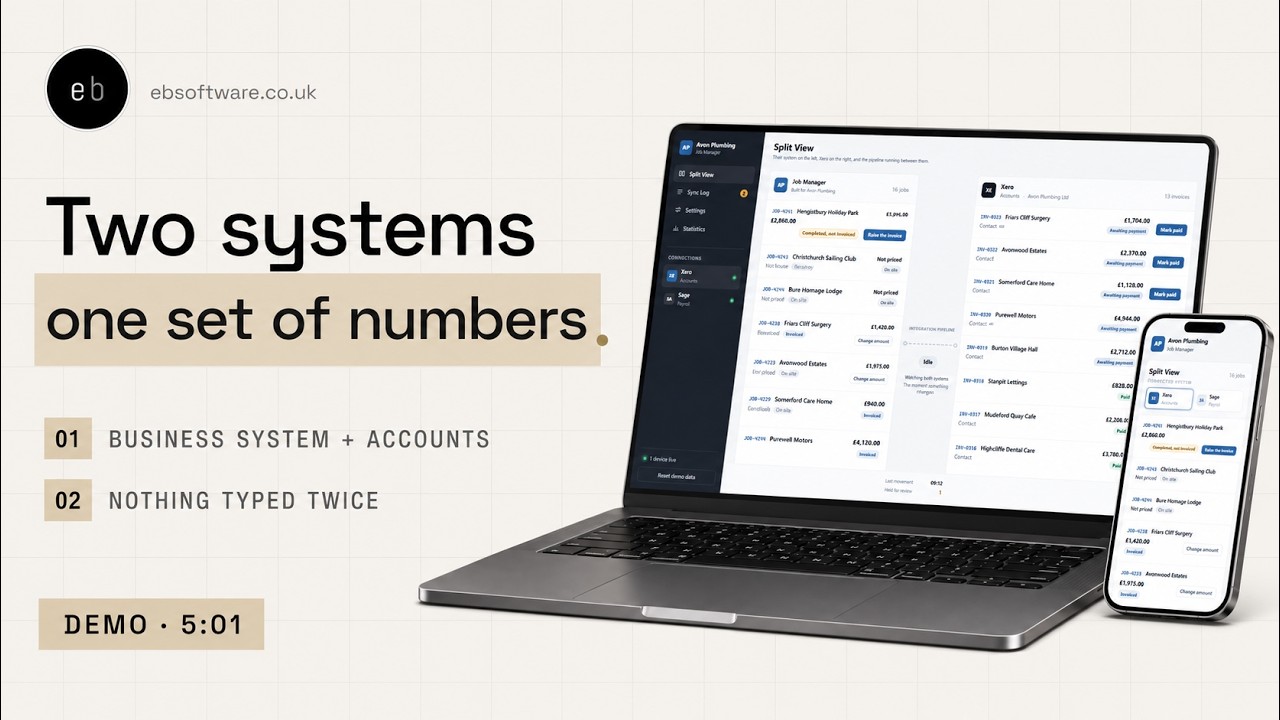
A business system and an accounts package kept in step both ways, a log of what moved and when, and a clash between two edits of the same record held for review rather than resolved silently. It is a real integration, built around the systems one business already ran.
It is flagged for someone to decide instead of the most recent change quietly winning. That is the difference between a sync you can trust and one that lets two systems drift apart without anyone noticing, and it is the reason a hand-run export is not the same thing as an integration.
Book a free consultation and we map out what your business needs, then give a fixed written quote with no obligation.
Most businesses do not run on one system, they run on five or six, and none of them talk to each other. An order lands in one place, the invoice is raised in another, stock is tracked in a third, and a person copies the same numbers between all of them. Software integration services close that gap, connecting two or more separate applications so they share data automatically, and a change in one is reflected in the others without anyone retyping it. The alternative is what most firms live with, islands, each application holding its own copy of the truth while staff act as the bridge between them, exporting a spreadsheet here, keying a figure in there, and hoping the two versions match. Disconnected systems rarely announce themselves as a problem, the cost hides inside jobs everyone accepts as “just admin”, a new customer typed into the CRM then the accounts system then the delivery app, numbers that disagree so nobody trusts the report, and headcount that rises in step with order volume rather than profit. Integration assumes the systems already exist and simply need wiring together, our guide on how systems integration works walks through the moving parts without the sales pitch.
Not every integration needs a developer, and we will tell you when it does not. Off-the-shelf connectors and iPaaS tools are genuinely good at simple, popular links, when a form is submitted, add a row to a sheet, when a deal closes, post a message. If your need is a light touch between two mainstream apps and the volume is low, use one and save your money. The limits show up quickly on real business processes though, connectors struggle when the logic gets specific, matching records that do not share a common reference, transforming data between very different structures, or coping gracefully when one system is down, and they charge per task, so a busy link that fires thousands of times a month can cost more each year than building it properly once. A bespoke integration is built for your exact case, applying your matching rules, transforming data the way your process needs, retrying on failure, and running on infrastructure you control rather than a third party’s rate limits. The honest test is the same as any build versus buy decision, if a ready-made connector does the job reliably, keep it, when it starts fighting your process or cannot reach one of your systems, that gap is where a developer earns their fee.
Integration is defined by the systems on each end, so specifics matter more than the label. The work usually falls into a few families:
For a longer list of systems we can connect to, from Microsoft 365 and Google Workspace to Shopify, Stripe and AI tools, see our integrations page. If two of your systems ought to share data and currently do not, that is the job, whether or not it fits one of these boxes.
We start by mapping what each system holds, what should flow, in which direction, and how the two describe the same thing differently, because “customer” in one rarely lines up field for field with “customer” in another. Most modern systems expose an API, a defined way for other software to read and write their data safely, and where a system offers one we use it, where it does not, we find another supported route rather than anything that would void support. We build in retries, alerts and logs so a hiccup is visible and recoverable, not a silent corruption, and we design integrations to move only the fields required for the job and keep transfers encrypted, the practical side of your obligations under the UK GDPR. Cost depends on how many systems are joined, whether data flows one way or both, and how much the structures differ, a single well-behaved link between two modern systems is a modest, quick piece of work, a network of several older systems with fiddly matching rules is a larger project measured in weeks. If your team is still ferrying the same order, invoice or customer record between screens by hand, get in touch or call 01202 237027 and we will tell you honestly whether a connector will do or whether it needs building properly, or see our bespoke software cost guide for how projects like this are priced. Our Signs & Stickers project record describes one such bridge, pulling every order, customer and attribution record out of WooCommerce into a portal that never writes back.
Orders, invoices and customer records update everywhere at once, instead of being re-typed between separate applications.
Matching rules, data transformation and the order things happen in are shaped around how your business actually works, not a generic connector template.
Retries, alerts and logs mean a failed sync is caught and fixed, not a silent gap nobody notices until month end.
Still not sure? A free consultation is the quickest way to find out.
Talk to usIt is connecting two or more separate applications so they share data automatically, without anyone retyping it. When an order, invoice or customer record changes in one system, an integrated setup updates the others directly, removing the manual re-keying that keeps disconnected systems roughly, but never quite, in step.
Off-the-shelf connectors are ideal for simple, low-volume links between two popular apps, and we will say so if that fits you. A custom integration earns its place when the logic gets specific, when the per-task cost of a connector climbs, or when one of your systems is not supported by any ready-made tool.
Usually yes. Most modern software exposes an API, a supported way for other applications to read and write its data, and where one exists we can build a connection. Where a system has no API, such as an older or bespoke application, we find another supported route or add an interface through custom development.
It depends on how many systems are joined, whether data flows one way or both, and how much the structures differ. A single link between two modern systems is a modest job, a multi-system, two-way network with older software is larger. We give a fixed written quote after a free consultation, once we have mapped your systems.
The next step
Book a free consultation: thirty minutes, no jargon, no obligation. We’ll map out exactly what would help.