One list of truth
Every enquiry, quote and customer in one place, so nothing gets left in an inbox or a notebook.
Use cases
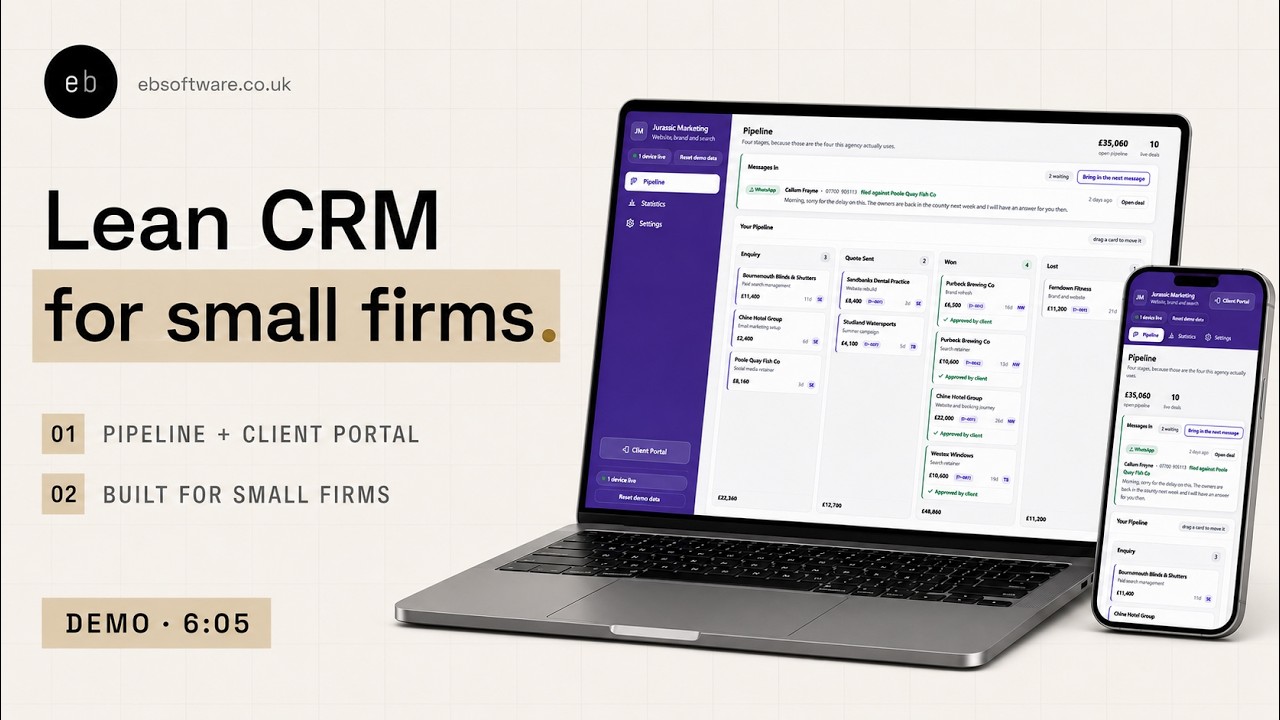
Most small businesses do not need a bloated enterprise CRM. They need somewhere simple to keep track of customers, leads and who needs a follow-up call.
 6:05
Plenty of small businesses run their customer relationships out of a spreadsheet, an inbox, or whatever the person who dealt with the enquiry can remember. It works fine until it does not, a lead goes cold because nobody followed up, two people chase the same customer, or the one person who keeps it all in their head goes on holiday. The problem for a lot of small businesses is that the well-known CRM platforms are built for companies far bigger than them. You end up paying a monthly fee per user for a system stuffed with modules you will never touch, then spending weeks trying to configure it down to something that actually fits how you work, or the forms ask for data you do not collect and hide the fields you actually need, so people skip them and the data rots.
If your sales process is fairly conventional and a mainstream CRM’s core fits without much bending, take it, do not over-think it. Build bespoke when the fit keeps breaking down, your team quietly runs the real system in a spreadsheet alongside the CRM, or the way you win and deliver work is a genuine edge that no generic pipeline supports. Building means you own an asset instead of renting a seat, no per-user fees stacking up every year, and a system carrying only the fields you use. Over a few years, for a core tool you use every day, ownership often costs less than the licences and fits far better. We walk through the full reasoning in bespoke vs off-the-shelf software. This page is about a CRM sized for a small business, if you are weighing up custom CRM from the ground up for a larger team, that is covered in CRM software and CRM software development.
Most of what a small business genuinely needs comes down to a focused set of features, done to fit: a clean contact and company record with only the fields you actually capture, a shared activity history of calls and notes logged against each contact, a pipeline that matches your real stages from first enquiry through to won or lost, and reminders that tell people what to do next instead of relying on someone remembering. Because it is bespoke, we can connect it to your accounting software, booking system or website enquiry form, see how systems integration works, so a new lead lands directly in the CRM rather than being typed in by hand. If capturing and routing enquiries is your main pain, a focused lead management system may be the better starting point, and if your goal is retiring the spreadsheet the whole team leans on, start with moving from spreadsheets to a database.
What you pay tracks how much system there is to build, and a small-business CRM is deliberately lean, the real cost drivers are how many pipeline stages and custom fields your process needs, and whether contacts flow in automatically or get typed in by hand. Set that one-off build against the running meter of a subscription, a per-seat CRM charges you every month for as long as you use it, and the day you stop paying the records leave with it. For many small businesses the sums cross over inside a couple of years. A CRM also holds exactly the information UK data-protection law cares about, and building it around your business lets you decide who can open which records and how a full record is wiped when someone exercises their right to be forgotten, the Information Commissioner’s Office sets out UK GDPR guidance for small businesses, and we build to it as standard. See our bespoke software cost guide or go straight to pricing.
If it helps to read one described end to end, our London page follows a firm that reached this point at about twenty people and what replaced the spreadsheets that had grown up around its CRM. If quotes are going cold because nobody chased them and your customer list is really three inboxes and a spreadsheet, contact us or call 01202 237027 to book a free, no-obligation chat.
Every enquiry, quote and customer in one place, so nothing gets left in an inbox or a notebook.
Reminders and simple pipelines mean leads get chased at the right time, not whenever someone remembers.
Off-the-shelf CRMs are built for every industry at once. We build only the fields and screens your business actually uses.
Still not sure? A free consultation is the quickest way to find out.
Talk to usBuy off the shelf when your process is conventional, you need it next week, and a mainstream tool fits without much bending. Build bespoke when the fit keeps breaking down, you are paying for a big platform but using a corner of it, or the way you win work is an edge no generic pipeline supports.
The main cost drivers are how many pipeline stages and custom fields you need, whether contacts arrive automatically or get typed in by hand, and whether you add extras like a customer portal. A plain contacts-and-pipeline system stays a modest build, and you get a fixed written quote after a free consultation, once we understand how you sell.
Yes. Because the CRM is built around your business, you decide who can open which customer records, how long a lapsed contact's details are kept, and how a record is wiped when someone asks to be forgotten. The ICO publishes UK GDPR guidance for small businesses, and we build to it as standard.
Yes. Migrating your existing contacts, from spreadsheets, your email, or an old CRM, is part of the launch stage. We map your old data into the new structure, bring across your history, and go live carefully so nothing is lost in the move.
The next step
Book a free consultation: thirty minutes, no jargon, no obligation. We’ll map out exactly what would help.