One record per customer
Every call, email, quote and note attached to the contact, so nobody has to ask "did anyone speak to them?"
Services
A bespoke CRM built for the way your team actually sells, so every contact, deal and conversation lives in one place instead of scattered inboxes and spreadsheets.
 6:05
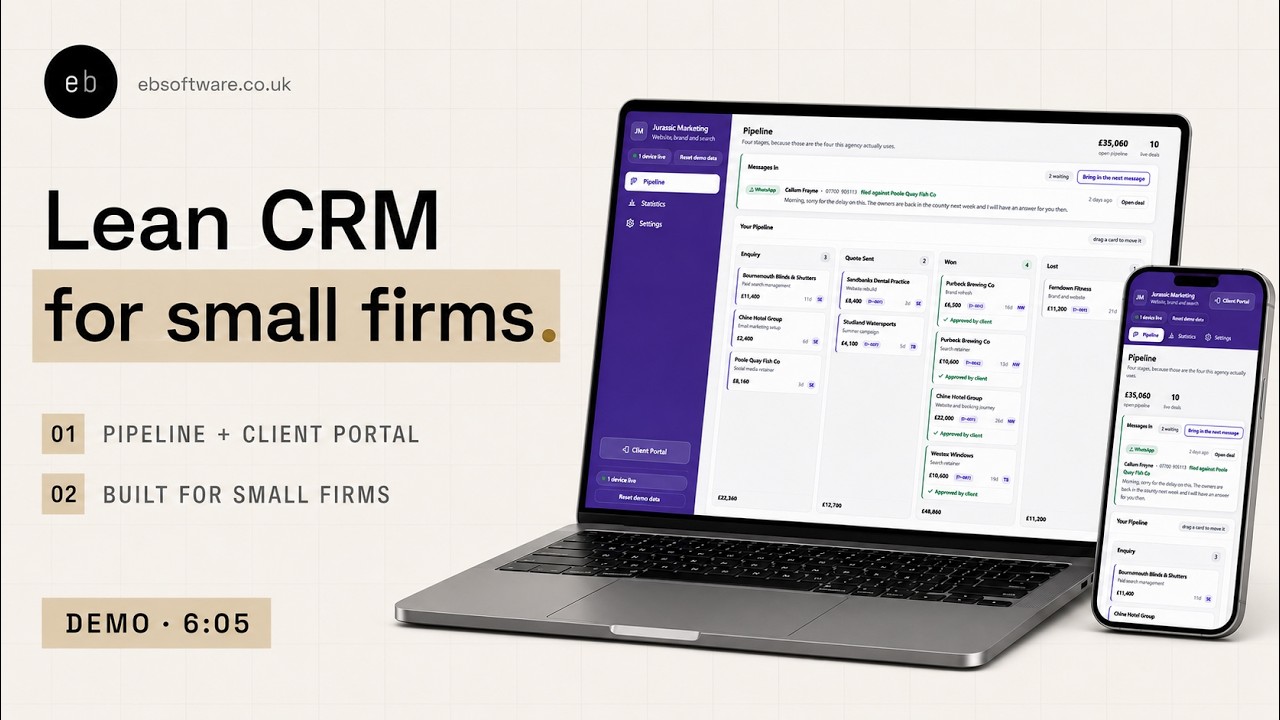
A pipeline that carries an enquiry through to won or lost, a contact record holding the calls, emails and notes together, and a client portal where a client signs in to see their project status, their shared documents and their invoices, and can approve a proposal there rather than by email. It is a real system, built for an agency around the way that firm already works.
A CRM only stays useful while it is up to date, and the usual reason one stops being trusted is that it arrived with dozens of fields nobody fills in. Carrying only what a firm actually uses makes keeping it current close to no effort, which is the difference between a system that sticks and one that is abandoned after a few months.
Book a free consultation and we map out what your business needs, then give a fixed written quote with no obligation.
Packaged CRM software has to be generic, sold to sole traders and multinationals from the same box, it ships with a fixed idea of what a lead, a contact and a deal mean. For a lot of businesses that gap shows up as the same recurring frustrations, whole modules sit untouched yet you pay for them in every monthly seat, the pipeline does not match how you win work so people bend the record to make it advance, or reporting means exporting because the dashboard will not answer the question your directors keep asking. None of this makes off-the-shelf CRM software wrong, for plenty of businesses a mainstream product is genuinely the smart buy, and we will say so plainly. The trouble only starts when you are paying for scale you do not have and reshaping how you sell to fit a form somebody else designed, bespoke vs off-the-shelf software frames the decision honestly.
CRM software covers a wide spread of needs, and the right starting point depends on yours. A smaller team paying for a platform built for a 200-person sales floor should start with CRM for small business, which keeps only the handful of fields you actually use. If you already know you want a custom system designed from your pipeline up, CRM software development is how a project runs end to end. Where your process shifts often and you want to add stages yourself, look at customisable CRM software, and when the whole game is capturing and working leads fast, a dedicated lead management system may matter more than a broad CRM. Contractors and manufacturers sell differently again, see construction CRM and CRM for manufacturers. Regulated sectors should see CRM for financial services or recruitment CRM software, and where clients log in to see their own jobs, a client portal wires into the same records your team works from. If those two words keep blurring into one another, the difference between a CRM and a client portal is set out in plain terms, with a video.
Three things sit at the core, the contacts you deal with, the history of every call and email against each of them, and the pipeline of live opportunities showing what stage each deal has reached. Everything else a CRM might offer, forecasting, quotes, dashboards, hangs off those three foundations, and when they are solid, work stops slipping, nobody rings a customer twice and when a salesperson leaves the relationships stay with the business. Bespoke CRM software earns its place when the fit breaks down, every stage, status, field and report is named and shaped the way your business already works, so your salespeople keep it up to date because logging a call takes seconds and the next action is obvious.
A custom CRM is priced by the work it takes to build, driven by how much of your pipeline the system covers, how many people use it, and how many integrations it needs to your accounts package and website. A single-team pipeline is a modest project, a multi-department system feeding live reports and a portal is a larger, staged investment, see how long bespoke software takes for typical ranges. CRM software is, by its nature, a store of personal data, so because a bespoke build is built to your rules, you decide exactly who can see which records and how a person’s data is found and removed when they ask, the practical shape of your duties under the UK GDPR, as set out by the Information Commissioner’s Office.
A worked example of one, a professional services firm whose CRM handled contacts perfectly well but had stopped matching how the business actually ran, sits on our London page. Where the pipeline needs feeding rather than only tracking, marketing automation for small businesses covers the campaign side of the same records, and where the contacts are applicants and learners rather than customers, a student CRM is the same idea shaped for education. If your CRM has become a box people tick reluctantly while the real pipeline lives in someone’s spreadsheet, contact us or call 01202 237027 for a free, no-obligation chat, or see pricing for rough numbers first.
Every call, email, quote and note attached to the contact, so nobody has to ask "did anyone speak to them?"
Deal stages, statuses and fields set up to reflect how you actually sell, not a generic template you have to bend to fit.
See where deals stall, which sources convert, and how repeat business builds, without exporting to a spreadsheet to work it out.
Still not sure? A free consultation is the quickest way to find out.
Talk to usOff-the-shelf CRM software is a ready-made product rented by many companies, with a fixed idea of what a lead, contact and deal are. Bespoke CRM software is built for one business, so every stage, field and report matches how you really sell, and you own it outright.
Cost is driven by scope, how much of your pipeline the system covers, how many users it has, and how many integrations it needs to accounts, email and web. A focused CRM for one team is a modest project, a multi-department system with a portal is a larger investment.
It depends on your situation. Smaller teams paying for scale they do not have should look at CRM for small business, firms that want to adjust the system themselves at customisable CRM software, and high-volume sales teams at a dedicated lead management system.
Yes. With a bespoke build you own your source code and your customer data outright, no per-seat licence you pay forever and no lock-in. The CRM is an asset that belongs to your business, and you control exactly who can see which records.
The next step
Book a free consultation: thirty minutes, no jargon, no obligation. We’ll map out exactly what would help.