The schedule builds itself
Recurring visits generate automatically from each asset's interval and each contract's frequency, mapped across the year so labour and travel plan themselves.
Services
We build PPM software that turns a contract's assets and visit frequencies into a rolling schedule, dispatches the job, and captures the certificate that proves it happened on time.
 5:55
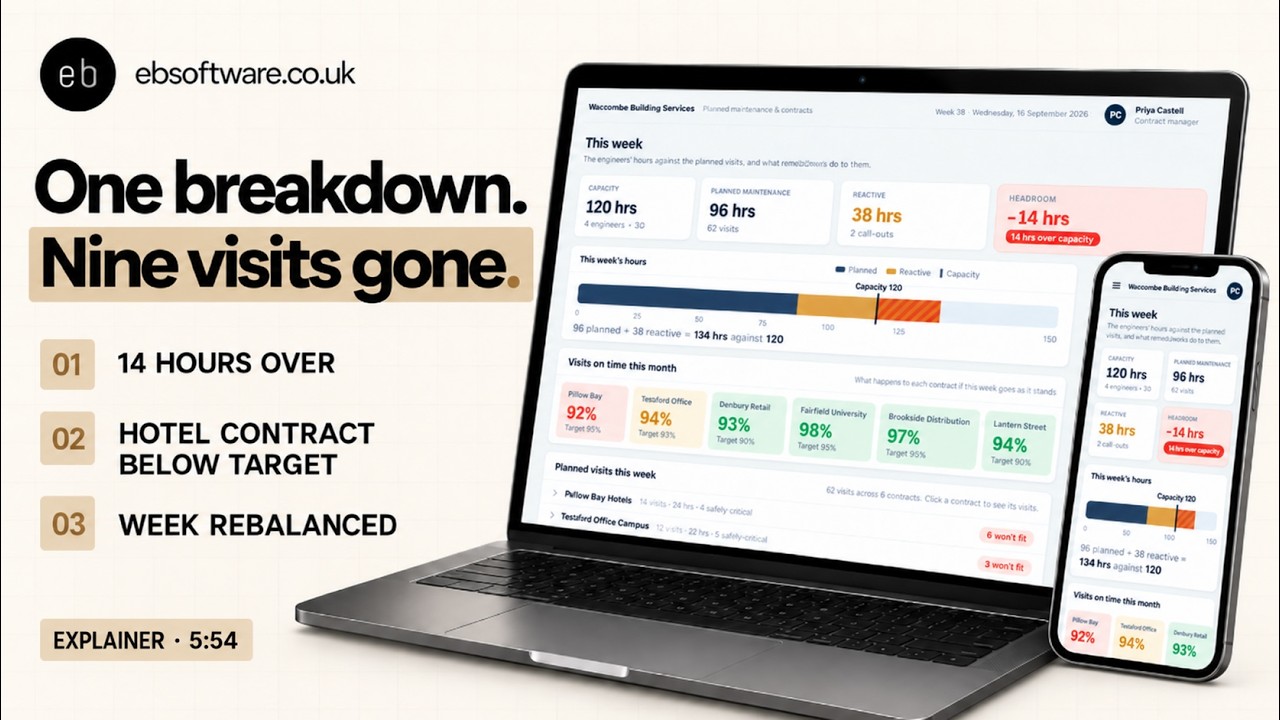
A contractor with six maintenance contracts and four engineers logs two breakdowns, which put the week fourteen hours over what the engineers can do. The system lists the nine planned visits that no longer fit and shows the hotel contract dropping below its target. One click moves the visits that can safely wait, Saturday overtime covers the rest, and the client's monthly report updates itself.
No. The example has four engineers and six contracts, but the problem is the same with two engineers or twenty: reactive work and planned work compete for the same hours, and a contract's target only means something if you can see it slipping before the month ends.
Book a free consultation and we map out what your business needs, then give a fixed written quote with no obligation.
Planned preventative maintenance is the discipline of servicing equipment on a set cycle so it keeps working, rather than waiting for it to fail, fire alarms, lifts, boilers, extraction, pressure systems. This page is about maintaining physical assets and plant, not the legal contract lifecycle management tools that happen to share the PPM and CMMS letters. PPM software runs that cycle, holding a register of every asset you look after, knowing the interval each is due at, and turning those intervals into a rolling list of visits to plan, dispatch and prove complete, whether you maintain your own buildings in-house or deliver maintenance to clients under contract. The terms PPM and CMMS get used interchangeably, but they pull in different directions, a CMMS is asset-first, built around a register of plant and its work-order history for a fixed estate you own, while PPM software is schedule-first, built around the calendar of recurring visits and the compliance clock behind them, suited to a contractor servicing many assets across many client sites. Most real systems are both, weighted toward whichever half hurts most, and building your own lets you set that weighting yourself. If your focus is the upkeep of a whole building estate you occupy or manage, reactive helpdesk, PPM and compliance for one operation, that broader picture is facilities management software, this page is for the scheduled, contract-driven side.
Packaged maintenance products do a reasonable job for a single in-house team on a standard regime, and the fit frays fast once you are a service firm delivering PPM to clients. Each client agreement sets its own scope, visit frequency, SLA and price, and the software needs to generate the right schedule per contract, not one flat list, and boxed tools treat the contract as an afterthought. The same asset type can carry a hundred variations, a fire panel quarterly at one site and monthly at another because an insurer demands it, and rigid products make you override the schedule by hand every time. Your client is not buying a visit, they are buying proof, a signed, dated, standards-referenced certificate, and if the system cannot produce and store that against the asset, you are back to Word templates and a shared drive, and a contract that lapses unnoticed is lost recurring revenue that a generic tool rarely watches for. None of that makes the product bad, it means the firm has outgrown its assumptions, the point at which any business weighs building against buying.
We build the system around how your maintenance business actually runs. A contract-driven asset register, every asset you maintain, with location, client, make, install date, warranty and full service history, grouped under the contract that covers it. A PPM scheduler, recurring visits generated automatically from each asset’s interval and each contract’s frequency, mapped across the year so labour and travel plan themselves, and jobs that raise themselves when a service falls due, with no one re-keying a diary every Monday. Certificate capture and output, a completed service producing its certificate against the asset, stored and searchable so proving compliance is a click rather than a rummage. And renewals and revenue tracking, contract end dates surfacing in good time so the recurring value of your maintenance book is visible rather than buried, alongside the overdue view, one honest screen showing what is late, what is due next and where the risk sits.
A PPM system earns its keep at two edges, the engineer on site and the back office. At the site edge, our bespoke audit and inspection app is the field half of the same system, an engineer opens the day’s planned jobs on a phone or tablet, works through the asset checklist offline with no signal, and captures photos, readings and a signature that flows straight back to close the job and attach its certificate. Where engineers also pick up ad-hoc breakdowns between planned visits, that reactive side sits alongside field service scheduling or a trade system such as software for electricians or plumbing and heating job management. Where the work is specifically life safety systems, the record has to go a level below the asset, down to each panel’s zones and devices, which is fire alarm servicing software. At the back-office edge, the visits PPM generates become invoices, the parts fitted come out of stock, and the contracts it renews feed your recurring revenue, the kind of joining-up covered by systems integration. Cost follows the shape of your operation, how many assets and sites you track, how varied your contract frequencies are, whether engineers need an offline app, a focused scheduler that retires the maintenance spreadsheet is a modest project, a full contract-driven platform with a field app and finance integration is a larger investment, see our bespoke software cost guide and how long bespoke software takes for the fuller picture. If a statutory visit has ever slipped because it lived on a spreadsheet no one truly owned, get in touch or call 01202 237027.
Recurring visits generate automatically from each asset's interval and each contract's frequency, mapped across the year so labour and travel plan themselves.
A completed service produces its certificate, stored and searchable against the asset, so proving compliance is a click rather than a rummage through a shared drive.
A contract nearing its end date is flagged in good time, instead of lapsing unnoticed and quietly taking its recurring revenue with it.
Still not sure? A free consultation is the quickest way to find out.
Talk to usIt is the system that runs scheduled, recurring servicing of physical assets, a register of what you maintain, the interval each item is due at, the visits those intervals generate, and the certificate that proves each service happened on time. It is not the legal contract lifecycle management software that shares the same initials.
A CMMS, computerised maintenance management system, is asset-first, built around a register of plant and its work-order history for a fixed estate you own. PPM software is schedule-first, built around the calendar of recurring visits and the compliance clock behind them, suited to a contractor servicing many assets across many client sites.
Yes. The intervals depend on the equipment, for example LOLER thorough examinations every six or twelve months depending on the equipment, or to a written examination scheme, and F-Gas leak checks at a frequency set by the amount and type of gas in the system. Whatever interval applies to each asset, fire alarms included, can be built in so the schedule flags an inspection before its due date, with the examination recorded as the compliance certificate against the asset.
Cost follows scope specific to maintenance, how many assets and sites you track, how varied your contract frequencies are, whether engineers need an offline mobile app, how many certificate formats you produce. A focused scheduler is a modest project, a full contract-driven platform with a field app and finance integration is a larger investment.
The next step
Book a free consultation: thirty minutes, no jargon, no obligation. We’ll map out exactly what would help.