The quote becomes the budget
When a job is won, the estimate carries across as a budget broken down by phase and by labour, materials and subcontract, so every later cost has a line to be measured against.
Services
Manufacturers and contractors often learn whether a job made money weeks after it was invoiced, so we build job costing software that sets actual labour, materials and subcontract against the quote while the job is still running.
 9:04
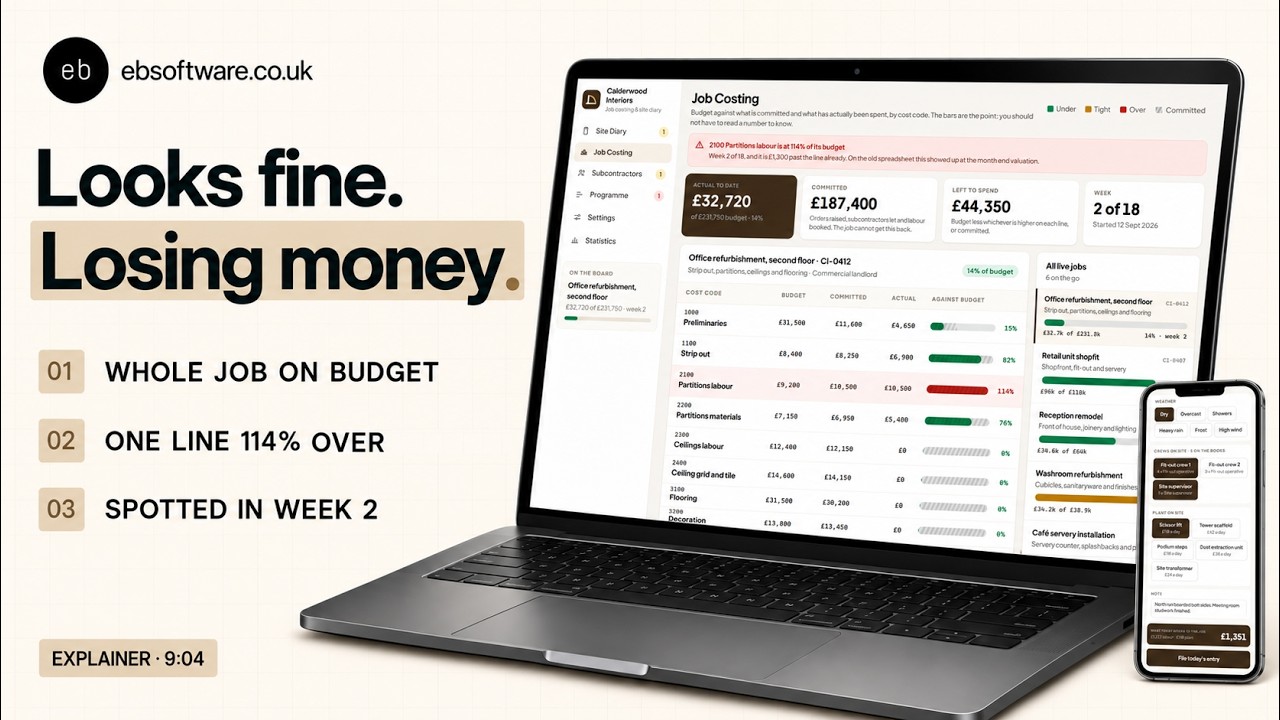
Why a job can be on budget overall while a single line within it is already over, and how booking costs against each part of the job as it happens shows that early. It follows one fit-out job, including a site diary entry made on a phone feeding straight into the costing.
No. The example is a fit-out contractor, but the same problem appears anywhere work is priced up front and delivered over weeks: joinery, engineering, installation, maintenance contracts. What changes is the names of the cost lines, not how the overrun is caught.
Book a free consultation and we map out what your business needs, then give a fixed written quote with no obligation.
Many firms that price work to order do some job costing, and many do it too late. The supplier invoices trickle in over the following month, the timesheets are totalled when payroll needs them, and some weeks after the job was delivered somebody works out that it lost money, when nothing can be done except feel bad about it. Job costing software is worth having only if it closes that gap, so that the contracts manager sees first fix running over budget before second fix is resourced, and the production manager sees that a batch has used more hours at welding than the whole job was quoted for while it is still on the bench. That is as true for a fabricator or joinery shop as for a builder or an M&E contractor. A firm with only a few jobs live at once can tag invoices to a job in the accounts package, keep a spreadsheet beside it and need nothing from us. The case for more begins when labour is the largest cost and none of it reaches the accounts until payday.
The quote becomes the budget. When a job is won, the estimate from our quoting and estimating software, or from your own, carries across broken down by phase and cost type, labour, materials, subcontract, plant and hire, because a single total tells you that a job went wrong and never where. Actual costs then land against the same lines. Labour arrives from timesheets on site or from shop floor data capture in the factory, valued at a cost rate that includes employer’s costs, not the hourly pay. Materials arrive as issues from stock and as supplier invoices coded to the job. Subcontract arrives from orders and applications. The part most spreadsheets miss is committed cost, the purchase order raised but not yet invoiced, which is why a job can look healthy right up to the month the bills land, so orders raised in purchase order software count against the job as soon as they are raised. Variations change the budget and the selling price together, the gap our post on what was quoted and what was actually done describes from the engineer’s side.
With budget, actual and committed in one place, the useful numbers follow. Each live job shows cost to date against budget by phase, an estimate to complete that the job’s manager can adjust, and a forecast final margin against the quote. Across the business, the same data gives work in progress, the cost sitting in unfinished and unbilled jobs, a figure your accountant needs at month end and one that is miserable to build by hand. For contractors we can track applications for payment and retention held against each job, and for manufacturers the cost of scrap and rework by operation. Posting the results into Xero or Sage is ordinary integration work, so the management accounts and the job reports agree. Where you also need the enquiry, scheduling and site side of contracting, that is our construction job management software, and on the factory side costing usually sits on the works order. Finished jobs then become a record the estimators can search, quoted against actual on similar work, which is how the next price improves.
Cost follows the number of cost sources that have to be joined up, the detail of the phase structure, and whether work in progress and forecasting are in scope. Where the jobs and hours already sit in a system, adding costing is a modest project. Our bespoke software cost guide explains how we price, and we will say plainly if your accounts package can already do what you need.
If you find out which jobs made money only when the year-end accounts arrive, contact us or call 01202 237027 for a free consultation.
When a job is won, the estimate carries across as a budget broken down by phase and by labour, materials and subcontract, so every later cost has a line to be measured against.
Hours from timesheets or shop floor scans at a true cost rate, materials issued from stock, supplier invoices and purchase orders not yet billed all post to the job and phase they belong to.
Each live job shows cost to date, committed cost, an estimate to complete and the forecast margin against the quote, so an overrun on first fix is visible before second fix begins.
Still not sure? A free consultation is the quickest way to find out.
Talk to usIt collects every cost that belongs to a job, labour hours, materials, subcontractors, hire and an agreed share of overhead, and compares the total with what was quoted. Good job costing does this by phase and while the job is live, so the comparison can change decisions and not only explain the result.
Estimating is the forecast made before the job is won, and job costing is the measurement made once it starts. The two should share a structure, so the phases and cost types in the quote are the ones the actuals are recorded against. We build both, and they are most useful joined together.
Many accounts packages can tag an invoice to a job, and for a firm running a few jobs at a time that and a spreadsheet is enough, and we will tell you so. Bespoke earns its place when labour is your largest cost and lives on timesheets, when you need purchase orders counted before they are invoiced, or when you want margin by phase across dozens of live jobs.
Cost follows scope, chiefly how many sources of cost have to be connected, how detailed the phase and cost code structure is, and whether work in progress and forecasting are included. Costing built on to a system that already holds your jobs and hours is a modest project, and a standalone build with integrations to stock, purchasing and accounts is a larger one. Every project starts with a free consultation and a fixed written quote.
The next step
Book a free consultation: thirty minutes, no jargon, no obligation. We’ll map out exactly what would help.