A revision trail, not a list of uploads
Raising a new revision creates a draft, routes it for approval, and only supersedes the current version once signed off, with the previous revision archived, not deleted.
Services
We build document control software around your approval chains, version control and controlled-copy distribution, so everyone works from the current, authorised version and every step leaves a record.
 6:05
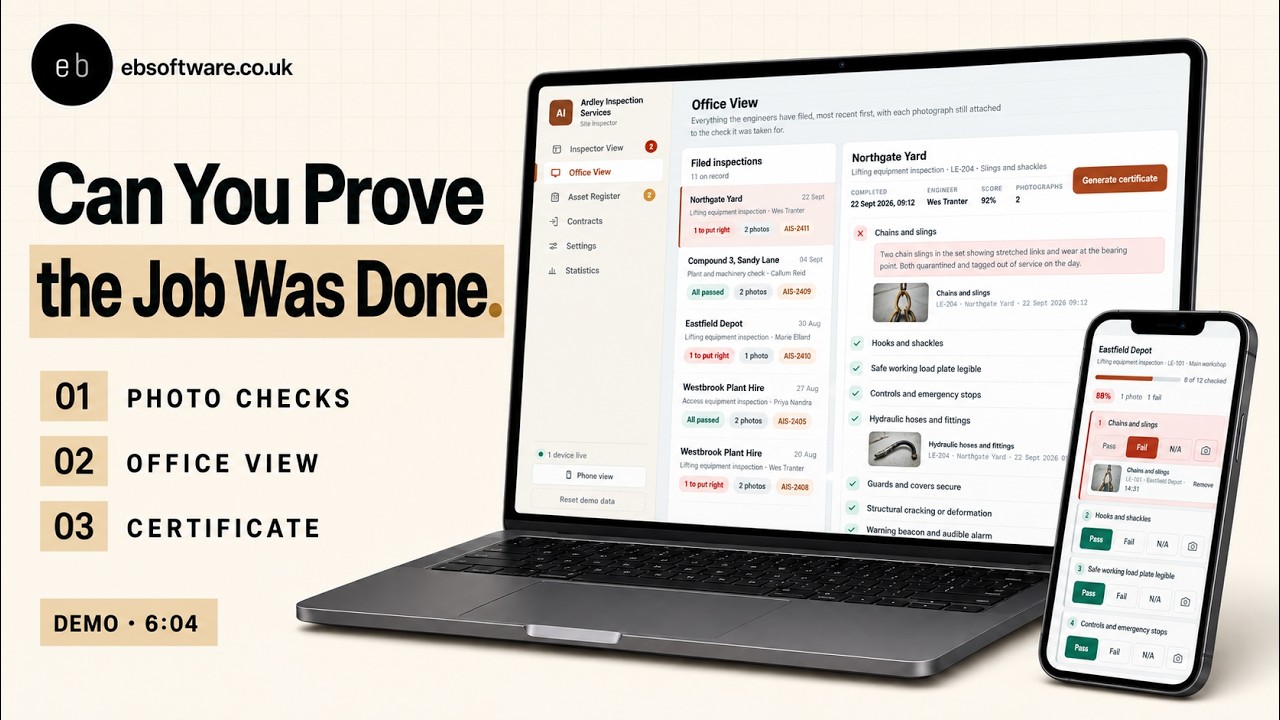
What proof actually means on an inspection round: what was checked, when, by whom, and what was done about anything that was not right. A twelve-item checklist is worked down on a phone, a photograph attaches to the individual check it belongs to, the inspection is signed off on the spot, and the office has a plain record of inspection while the visit is still today.
No. The example is a lifting and plant round, but the shape is the same for any inspection, servicing visit or maintenance schedule where somebody has to show what was done: fire and electrical rounds, facilities checks, vehicle inspections or planned maintenance. The checklist changes. The problem does not.
Book a free consultation and we map out what your business needs, then give a fixed written quote with no obligation.
If your quality manual, work instructions and forms live in a shared drive nobody fully trusts, you know the problem, the wrong version gets used, approvals happen by email, and an auditor’s simple question, show me who signed this off and when, becomes an afternoon of digging. Document control is the set of rules governing how important documents are created, reviewed, approved, issued, changed and eventually retired, so everyone always works from the current, authorised version, never an old one. It is not the same as storing files, a folder of PDFs is document storage, document control is knowing which PDF is live, who approved it, what changed since the last revision, and who may see or edit it. A controlled document carries a unique reference and revision number, can only be changed through a defined approval route, has superseded versions withdrawn from use, and leaves a record of every step, think of a manufacturing work instruction, a method statement, a policy, a calibration procedure. The practical test is simple, if someone on the shop floor, on site or at a desk could act on an out-of-date instruction without realising, your documents are not controlled, merely stored.
Plenty of products claim to do document control, a general document management system stores, searches and shares files well, but its idea of approval is often a single tick box, and its version history is a list of uploads rather than a governed revision trail. A broad quality management platform may bundle document control alongside audits, non-conformances, training and risk, powerful, but priced and shaped for a large compliance department, with a rigid workflow you must bend to fit. The friction shows up in familiar ways, your approval chain has three signatories in a set order but the tool supports one, you need a controlled COSHH register or a non-conformance log tied back to the document that failed but the platform treats those as separate paid modules, and distribution matters, certain teams must acknowledge the new revision, but the software has no concept of a controlled copy or read receipt. So people quietly revert to the shared drive and a spreadsheet, and you pay a licence for a system nobody trusts, see bespoke software development for the wider build-vs-buy question.
A document control system is only as good as the everyday mechanics, so we build the parts that make control real rather than nominal. Governed version control, every document has a reference and a revision, raising a new revision creates a draft, routes it for approval, and only supersedes the current version once signed off, the previous revision archived, not deleted. Configurable approval chains, authors, reviewers and approvers in the order your standard requires, with role-based routing, deadlines and reminders. Controlled-copy distribution, when a revision goes live, the right people are notified, obsolete copies are withdrawn from use, and read-and-understood acknowledgements are recorded against each person, the evidence auditors ask for. A complete audit trail, who did what, when and why, held as a protected history you can produce on demand. And retention and review scheduling, documents flagging for periodic review before they go stale. Because it is your system, a controlled COSHH register, an NCR log or a supplier specification can live alongside the documents they relate to rather than as bolt-on modules, and for teams whose evidence is gathered out on site, this pairs naturally with a bespoke audit and inspection app feeding results straight back into the controlled record.
Standards drive most document control projects, ISO 9001 is the common one, it expects your quality management system’s documented information to be identified, reviewed and approved before use, kept current, available where needed, and protected from loss or misuse, with obsolete versions prevented from unintended use, certification is assessed by the certification body that audits you, not by us, we build systems that help you meet those requirements. Built well, a bespoke system turns audit readiness from a scramble into a search, approvals captured as work happens, every controlled document showing its revision, approver and distribution list in a couple of clicks. Document control rarely lives alone, we commonly connect it to an ERP or job system so a work instruction links to the product or process it governs, for manufacturers that often means document control sitting beside the quality functions inside a wider manufacturing ERP system, and for professional firms handling matter files under strict retention, the same discipline underpins tools like legal case management software, the general approach covered in how systems integration works. Cost tracks the time to build, how many document types and approval routes you need, whether you require controlled-copy acknowledgements, a focused system governing one library is a modest project, a system controlling documents across several sites with linked registers is a larger investment measured over months, see our bespoke software cost guide and how long bespoke software takes for the fuller picture. If you are tired of chasing which revision is current or gathering approvals by email, get in touch or call 01202 237027.
Raising a new revision creates a draft, routes it for approval, and only supersedes the current version once signed off, with the previous revision archived, not deleted.
Authors, reviewers and approvers in the order your standard requires, with role-based routing, deadlines and reminders, so a stalled approval is flagged rather than left unnoticed in an inbox.
When a revision goes live, obsolete copies are withdrawn, and read-and-understood acknowledgements are recorded against each person, kept in a protected history.
Still not sure? A free consultation is the quickest way to find out.
Talk to usIt is the discipline of managing important documents through their whole lifecycle, creation, review, approval, issue, revision and retirement, so everyone always uses the current, authorised version. Storing files is not the same thing, control means knowing which version is live and proving it.
It is a document whose lifecycle is governed by defined rules, carrying a unique reference and revision number, changeable only through an approval route, with a record of who approved it and when. Superseded versions are archived and withdrawn from use.
It expects the documented information in your quality management system to be approved before use, kept current, reviewed on a schedule, available where needed, and protected, with obsolete versions prevented from being used by mistake. Certification is assessed by the certification body that audits you, and software helps you meet the requirements.
When the fit has broken down, an approval chain your DMS cannot model, per-user licensing that punishes read-only access, no concept of controlled-copy acknowledgements, or quality records stranded in separate paid modules. If a mainstream product genuinely fits, keep it.
The next step
Book a free consultation: thirty minutes, no jargon, no obligation. We’ll map out exactly what would help.