Use cases

Construction project management software for main contractors.

Main contractors running several sites often keep programmes, instructions, compensation events and information requests in a separate spreadsheet per project, so we build construction project management software that holds time, change and information for every live job.

Video

See construction project management software in action.

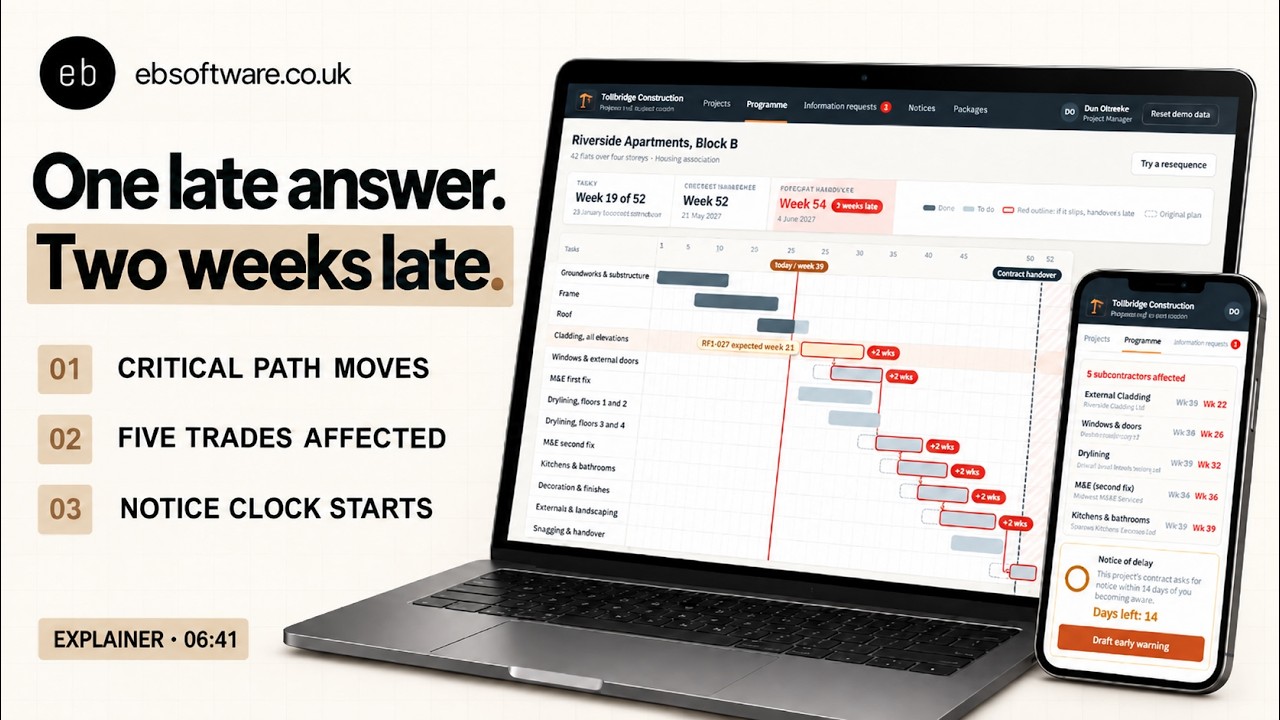
Why Building Projects Finish Late, and How to See It Coming video thumbnail6:41

Building jobs rarely finish late because of one big event. More often a small thing, such as an answer that is two weeks overdue, holds up every trade that depends on it. This follows one block of flats in week 19, showing how a programme that knows which work waits on which moves the handover the moment a date changes, lists the subcontractors affected and counts down the time left to give notice.

Length
6:41
See all videos

Questions about this video

What the video covers

How one overdue information request on the critical path moves the handover of a block of flats from week 52 to week 54, which work moves and which has the spare time to stay put, the five subcontractors whose start dates change, and the notice period that starts counting down. It ends with one change of sequence that brings a week back.

Whether this only suits blocks of flats

No. The example is a block of flats, but the same thing happens on schools, offices, shops or any job where one trade cannot start until another has finished. What changes is the list of trades, not how a late answer shows up on the handover.

How to get software like this

Book a free consultation and we map out what your business needs, then give a fixed written quote with no obligation.

What construction project management software is for

Construction project management software, for a main contractor or a larger specialist contractor, has to hold three things across every live project, time, change and information. Time is the programme and progress against it. Change is every instruction, early warning, compensation event and variation, each with dates the contract sets. Information is the design detail the site is waiting on and the subcontract packages that must be let before their trades are due. On one project a good project manager can hold all of it in spreadsheets. With several projects on different sites, the directors cannot see which job is drifting until the monthly report, and a notice missed on one of them can cost money the programme never shows. A contractor running many smaller jobs from enquiry to invoice is better served by our construction job management software. The money side, valuations, retention and cost value reconciliation, belongs to the commercial ledger, which this system feeds rather than replaces.

Programme, packages and information

The programme stays in the planning package your planners already use, such as Asta Powerproject or Microsoft Project, and its activities are imported where the package can export them, so site managers get a look-ahead of the coming weeks drawn from the master instead of redrawn by hand. Progress is recorded against activities from site, while the daily diary and snag lists stay with the site team’s own tools. Each subcontract package carries the date it must be let by, its lead time and its start on site, so a package still out to tender close to its start date shows up early, with the firms themselves vetted in subcontractor management software. Requests for information and technical queries carry the date an answer is needed to hold the programme, the consultant each sits with and the packages it affects, and an information required schedule goes to the design team from the same record.

Change, notices and the contract’s clock

The change register is the heart of it. Instructions, early warnings, compensation events, variations and notices of delay are logged against the project, with the periods for notification, quotation and reply entered from the contract, and the register shows what falls due this week across every job. Those periods differ by form of contract and by amendment. The standard NEC4 Engineering and Construction Contract gives the contractor eight weeks from becoming aware of a compensation event to notify it, and a late notice can cost the entitlement. JCT building contracts expect the contractor to give notice once it becomes reasonably apparent that progress is being or is likely to be delayed. Many contracts change these terms, so the system tracks the dates you enter, and what they mean for a given event is for you and your advisers. Each change item carries its value by stage, notified, quoted, assessed and agreed, which gives the commercial team the change element of the forecast final account without a separate spreadsheet.

Where bespoke fits, and what it costs

Packaged construction management software covers drawings, site forms and project records, and plenty of contractors run on it without needing anything built. The case for a build is narrower, the join between the change the site logs, the forecast the commercial team reports and the view the directors need across every job, whether that sits beside a platform you keep or replaces the spreadsheets around it. Cost follows the number of registers and how deeply the system connects to the rest, and our bespoke software cost guide explains how a fixed quote is built.

If each project keeps its own change spreadsheet and the directors see them once a month, contact us or call 01202 237027 for a free consultation.
What you get.

01

A change register that watches the clock

Instructions, early warnings, compensation events and variations are logged against the project with the periods your contract sets for notices, quotations and replies, so the team sees what falls due this week on every job.

02

Information chased before it holds up work

Each RFI and technical query carries the date the answer is needed to keep the programme, the consultant it sits with and the packages it affects, so late information shows up before it turns into a delay.

03

Every live project on one page

Directors see each project's progress against programme, open change by status and value, overdue information and packages still to let, drawn from the records the site and commercial teams already keep.

The difference it makes.

  • Compensation event and delay notice dates seen before they pass
  • Change valued at each stage, from notified to agreed
  • Late design information seen while there is time to chase it
  • Subcontract packages let in time for their start on site
  • Look-ahead programmes drawn from the master, not redrawn
  • One portfolio view for directors across every live project
  • A dated history of every instruction, notice and reply
  • Commercial forecasts fed from the change the site has logged

Questions, answered.

Still not sure? A free consultation is the quickest way to find out.

Talk to us

Job management follows each job from enquiry to final invoice and suits firms whose work is many smaller jobs. Construction project management software is for contractors running fewer, larger projects under a formal contract, where the risk sits in programme, notices, change and design information across several sites at once. The two can share one record where a firm does both.

It records them and tracks the dates you enter from your contract. The standard NEC4 Engineering and Construction Contract gives the contractor eight weeks from becoming aware of a compensation event to notify it, and JCT building contracts expect the contractor to give notice once delay becomes reasonably apparent, but amendments are common. What the dates mean for a particular event is for you and your advisers, and we give no contract advice.

Established construction platforms handle document control, site forms and project records well, and a contractor whose way of working fits one should use it. A build is worth pricing when change and portfolio reporting are the real problem, when the platform sits apart from your commercial and accounts systems, or when directors need a view across projects that its reports do not give.

The number of registers and the depth of the link to your commercial and accounts systems drive the figure. A change and RFI register across live projects is a modest project, and one with programme import, subcontract package tracking, a portfolio view and commercial integration is a larger one, usually built in phases. Every project starts with a free consultation and a fixed written quote.

The next step

Let’s build the software your business actually needs.

Book a free consultation: thirty minutes, no jargon, no obligation. We’ll map out exactly what would help.